
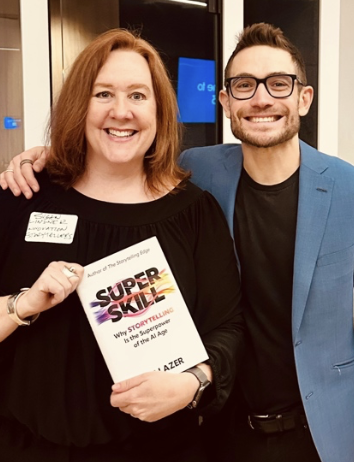
I went to a killer book signing last week at VC firm M13 in NYC, hosted by Axios—thanks to this week’s podcast guest, Joe Lazer. His new book, Super Skill: Why Storytelling Is the Superpower of the AI Age, is exactly the book we need right now. I was lucky enough to snag an advance copy.
Which is precisely why I invited Joe to join me for a special Storyteller Series episode—where I bring other brilliant communicators onto the show to share their perspectives on the art and science of great storytelling.
What’s funny is that just two years ago, venture capitalist Marc Andreessen was loudly predicting that AI would automate creative production—cranking out infinite content for free. Plenty of others piled on, forecasting the slow death of storytelling as a skill, a service, or even a profession.
Fast forward to today: Anthropic just hired a full-time storyteller for $500,000 a year. Turns out… storytelling didn’t die. It got promoted.
Consulting giants like McKinsey, Deloitte, and BCG saw this coming. One McKinsey product leader put it perfectly in their research:
“Great stories and great storytelling will always matter. AI can speed the workflow, but creativity still defines the outcome.”
Joe and I agree: storytelling isn’t going anywhere. In fact, it’s quickly becoming one of the most prized executive capabilities in the AI economy.
Why?
Because the human operating system for communication isn’t artificial. It’s deeply human.
Innovation requires Innovation Storytelling. AI value simply doesn’t scale without narrative clarity. If your people don’t understand your strategy, your why for using AI, and what the future looks like when it’s working, you’ll never get the buy-in or adoption you need to make your people—and your business—great.
AI can create content.
Leaders create meaning.
And when everyone has AI, the competitive advantage isn’t the algorithm. It’s the story that makes people act on the insight—and believe in the future you’re building.
Check out this week’s episode with Joe Lazer and get his book!
I’m curious, reply to the email and let me know, is your storytelling different since
the advent of AI?