
What does it really take for large organizations to keep innovating when speed, disruption, and AI are changing the rules faster than ever before?
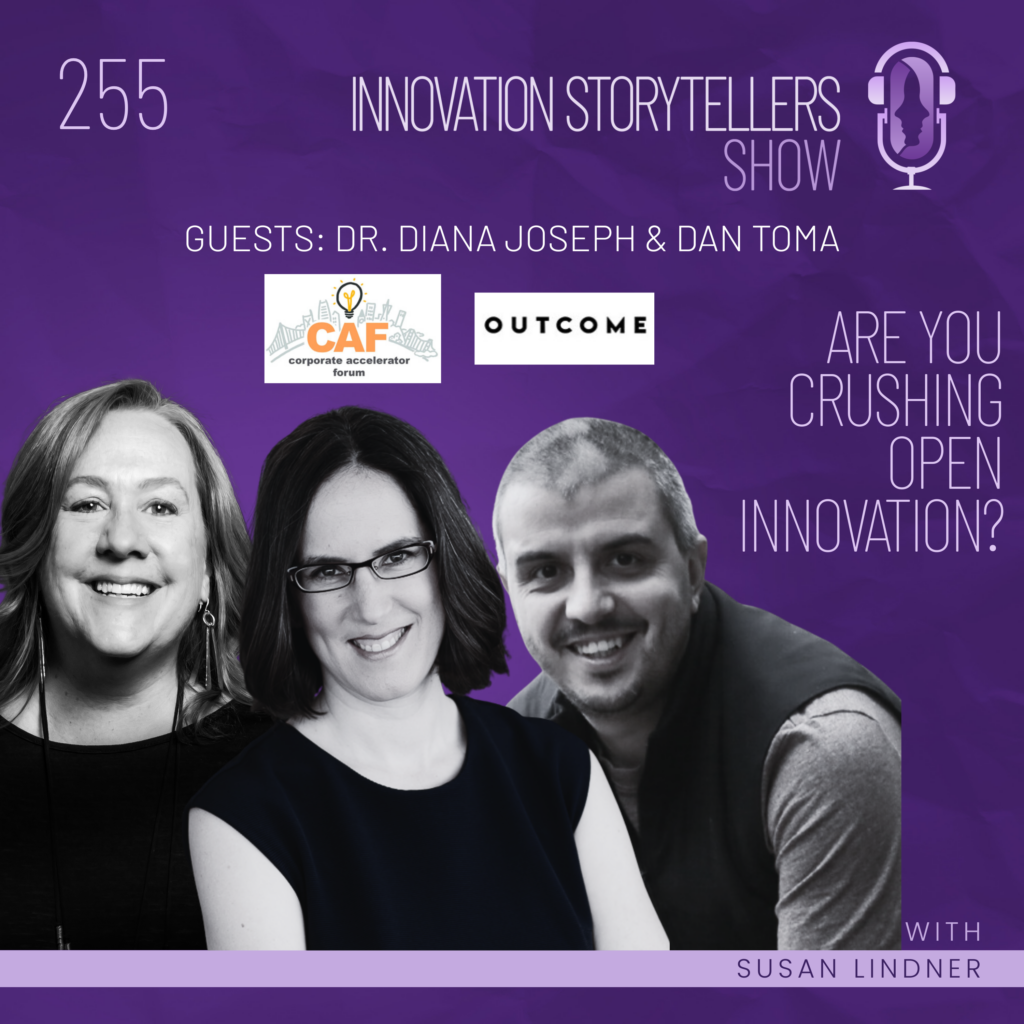
In this episode of the Innovation Storytellers Show, I’m joined by two returning guests whose work has shaped how many leaders think about innovation inside large organizations: Dr. Diana Joseph, CEO of the Corporate Accelerator Forum, and Dan Toma, co-author of The Corporate Startup and Innovation Accounting. Together, they return to discuss their new book, Open Innovation Works, and why open innovation has become a business necessity rather than a nice idea for the future.
We unpack why so many organizations struggle to innovate once they grow beyond their original breakthrough, and why the answer often lies outside the four walls of the business. From startup accelerators and incubators to university partnerships and corporate venture capital, Diana and Dan explain how companies can choose the right innovation vehicle rather than simply copying competitors. They also explain why alignment within the organization is often harder than working with startups.
The conversation also takes a timely turn toward AI, where both guests challenge the growing trend of creating isolated “AI departments.” Instead, they argue that AI should be treated like any other business tool, embedded across every function rather than locked inside another silo. It is a practical, honest discussion about why so many AI projects fail, what leaders are getting wrong, and how innovation teams can stay relevant by tying their work directly to business growth and measurable outcomes.
We also explore real-world examples from companies like Illumina and the lessons learned from cautionary tales like Borders and Amazon. At the center of it all is one simple question: if your organization cannot see the future clearly, who can help you borrow that vision?
If you’re leading innovation, navigating AI adoption, or trying to prove the ROI of transformation inside your business, this episode offers frameworks, perspective, and practical advice you can start using tomorrow. How is your organization making sure it doesn’t lose sight of what comes next?
Name: Dr. Diana Joseph
Title: CEO
Company: Corporate Accelerator Forum
LinkedIn | Corporate Accelerator Forum |
Dr. Diana Joseph, PhD, is the visionary leader of the Corporate Accelerator Forum, a consultancy focused on ecosystem development and partnership for large organizations and startups. Having discovered corporate innovation in the trenches at Adobe and Citrix, Diana consults on open innovation strategy as well as tactics, especially in highly-regulated industries. She convenes ecosystem events that magnetize stakeholders to understand and take on critical regional and industrial challenges.
Diana is a learning scientist and pioneer of education for digital creation. She creates AI building workshops for non-programmers, supports K-12 education and teaches at Drucker School of Management. She is the founder of Click | the Startup Accelerator for Corporate Partnership, a preparatory engine for startups who need to create healthy deals with large organizations. She recently published her first book: Open Innovation Works.
Name: Dan Toma
Title: CEO & Partner
Company: Outcome
LinkedIn | Outcome |
Dan Toma is an innovation thought leader and the author of Innovation Accounting (BIS, 2021) and The Corporate Startup (Vakmedien, 2017).
He comes from an entrepreneurial background. He has been involved with technology startups across the world and is an innovation community leader in Europe.
Puzzled by the questions ‘why are innovative products mainly launched by startups?’ He focuses on enterprise innovation-lead transformation – specifically on the changes blue-chip organizations need to make to allow for new ventures to be built in a corporate setting. In this capacity he worked with companies like Deutsche Telekom, Bosch, Jaguar Land Rover, Bayer, John Deere or Allianz.
Being a big advocate of the ecosystem approach to innovation, he has also worked with various government bodies, in Asia and Europe, helping develop national innovation ecosystems and implement national innovation strategies.
The work experience gathered from the public and private sector has been translated into various experiential courses that he has delivered for universities such as Royal Academy of Engineering or the University of Applied Science Rhein-Main.