
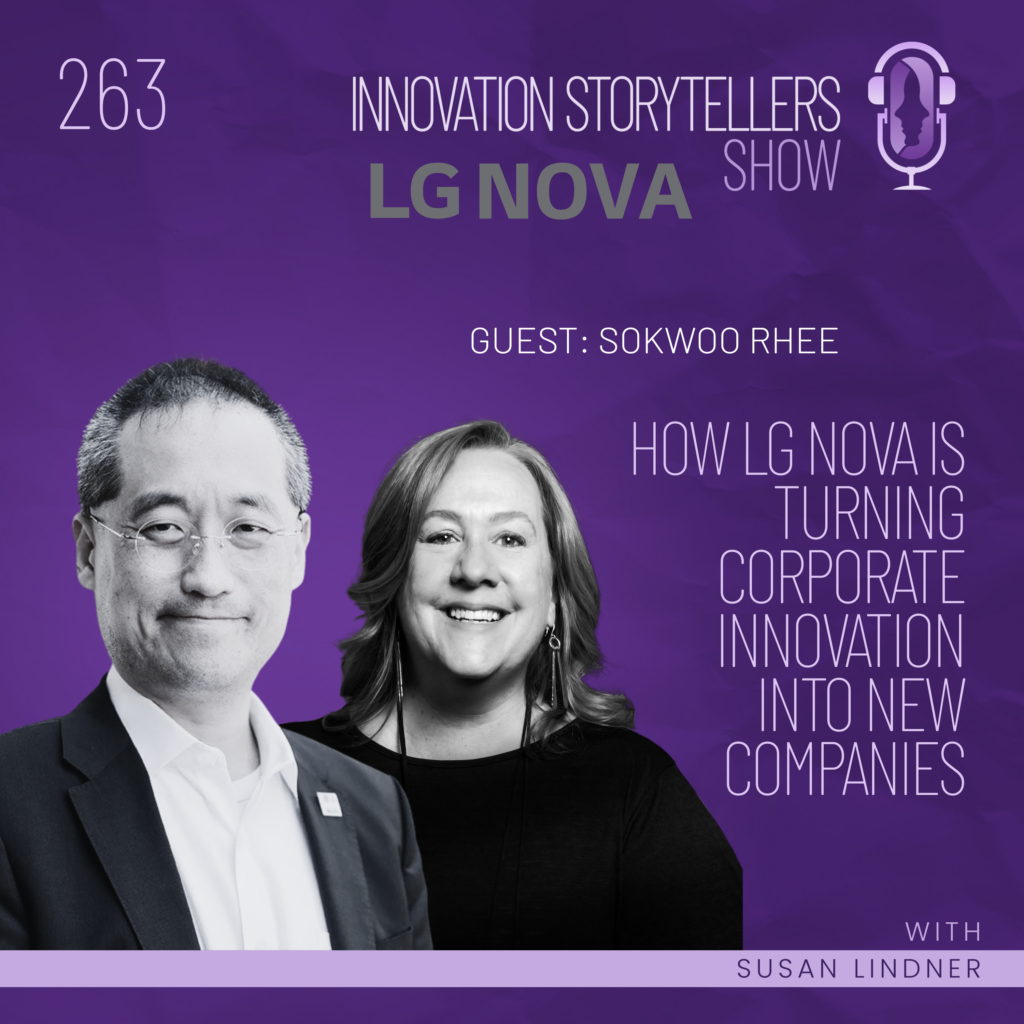
Could a company best known for TVs, appliances, and consumer electronics become a launchpad for entirely new businesses? In this episode of the Innovation Storytellers Show, I sat down with Sokwoo Rhee, Corporate Executive Vice President for Innovation at LG Electronics and Head of LG NOVA, to discuss why some of the world’s largest organizations are rethinking how innovation happens and what it takes to build the next generation of companies from within a corporate environment.
Sokwoo shares his journey from entrepreneur and government innovator to leading LG NOVA, LG’s Silicon Valley-based innovation center focused on creating entirely new ventures in areas such as healthcare, AI, energy, and digital services. We explore why innovation requires a different mindset from traditional business operations and why corporate leaders must be willing to invest in opportunities where the outcome is uncertain but the long-term potential could reshape an organization’s future.
Our conversation also examines the challenge of balancing quarterly business realities with long-term innovation goals. Sokwoo explains why successful innovation portfolios resemble venture capital strategies, where multiple experiments are necessary because breakthrough ideas rarely arrive with guaranteed outcomes. He offers a candid perspective on risk, leadership, failure, and the importance of creating space inside large organizations for ideas that may eventually define the next decade of growth.
We also discuss LG NOVA’s approach to building new companies, including its work in mental health technology, where AI is being used to help therapists spend more time supporting patients and less time on administrative tasks. Along the way, Sokwoo reflects on the role of storytelling in innovation, why evidence matters as much as vision, and how innovators can help organizations imagine futures that do not yet exist.
If you’ve ever wondered how corporate innovation can move beyond pilots and PowerPoint presentations to create entirely new businesses, this conversation offers a fascinating look inside one of the world’s most ambitious innovation initiatives. What role should large corporations play in building the companies of tomorrow, and how much risk are they willing to take to get there?
Name: Sokwoo Rhee
Title: Corporate Executive Vice President for Innovation
Company: LG Electronics and Head of LG NOVA
LinkedIn | Website | Follow LG Nova on LinkedIn
Sokwoo Rhee is Corporate Executive Vice President for Innovation at LG Electronics and Head of LG NOVA, a new Silicon Valley-based innovation center. He leads LG Electronics’ global innovation projects, new business creation, strategic partnerships, and ecosystem development. Prior to joining LG, Sokwoo served as Associate Director for Cyber-Physical Systems (CPS) Innovation at the National Institute of Standards and Technology, U.S. Department of Commerce, covering innovation programs for Internet of Things (IoT) and Smart Cities. He managed the Global City Teams Challenge (GCTC), a U.S. federal government program to develop a global ecosystem of major business and technology stakeholders to create replicable and scalable IoT/smart city projects. Sokwoo previously served as a Presidential Innovation Fellow on CPS, a program by the White House. During his tenure, he co-led the SmartAmerica Challenge, which brought together IoT technologies and organizations across the nation to demonstrate how they can collaborate to create technology-based projects with a focus on socio-economic benefits.
Prior to joining the U.S. government, Sokwoo was a co-founder and CTO of Millennial Net, Inc., one of the first organizations to successfully commercialize low-power wireless mesh/sensor networks and IoT technologies from academia. He also worked on wireless medical sensors as a research associate at the Massachusetts Institute of Technology. His work and achievements have been widely recognized and he has been the recipient of numerous awards, including the MIT Technology Review’s “Top Innovators under 35.” Dr. Rhee received his M.S. and Ph.D. in Mechanical Engineering from the Massachusetts Institute of Technology.