
Why do so many brilliant innovators become less persuasive the more expert they become?
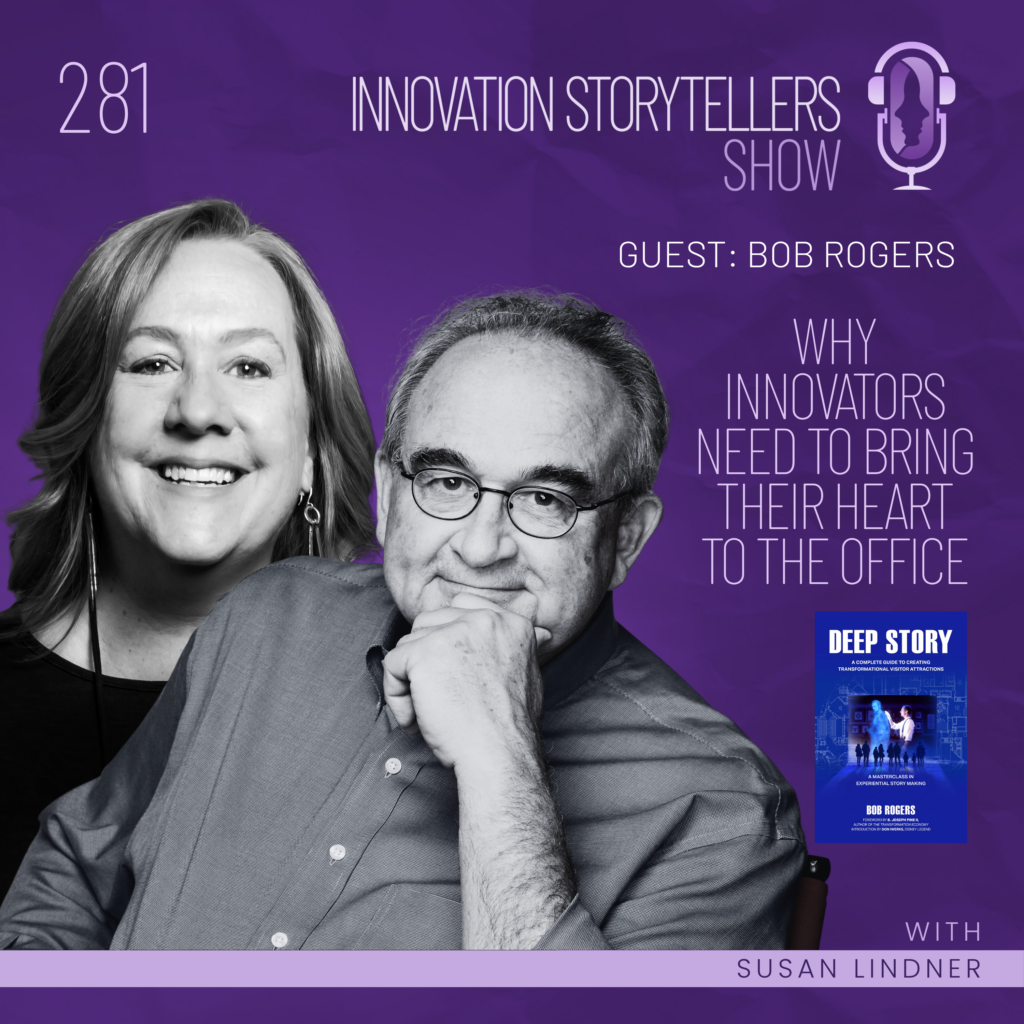
In this episode of the Innovation Storytellers Show, I speak with Bob Rogers, founder of BRC Imagination Arts, about something I think many innovation leaders forget when they walk into the office: people don’t leave their emotions at the door just because the conversation has become technical.
Bob has spent a career creating experiences that move people to feel something and then act. His story began as a magician at Disneyland, where he learned an idea that has stayed with him ever since. The point of a performance is not to show people how clever you are. It is to help them discover something within themselves.
The lesson became the foundation for a bigger idea: when we communicate innovation, it is about them, not us. We talk about why scientists, engineers, and technical leaders often become suspicious of emotion even though emotion frequently sits behind the reason they entered their field in the first place. Bob reminds us that many experts first fell in love with their subject as children, long before they understood the technical language, frameworks, or data that later defined their careers.
So why do we strip all of that fascination out when we present an idea to a CEO?
Bob argues that if you want to change behavior, you shouldn’t start with features, benefits, or a technical explanation. You need to understand the hopes, fears, problems, and ambitions of the person in front of you.
We discuss why experts often know too much for their own good when it comes to communication. A CEO, by necessity, is a generalist. If your innovation story requires specialist knowledge before someone can understand why it matters, you may have already lost them.
One of my favorite parts of the conversation is Bob’s explanation of why the story should come before the artifact.
He describes how a moon rock can become one of the most boring objects in a museum if you simply put it in a gray display case and attach a technical label. But if you first take visitors through the risk, danger, ambition, and human story of traveling to the Moon, that same gray rock becomes something extraordinary.
Bob has spent decades working at the intersection of imagination, experience design, storytelling, science, and business. This conversation reminds us that innovation doesn’t move forward because the facts are impressive. It moves forward when people understand why those facts matter to them.
When you present your next breakthrough, do you start with the technology or with the person you need to believe in it?
Name: Bob Rogers
Title: Founder of BRC Imagination Arts
LinkedIn | Website |
Bob Rogers is the founder of BRC Imagination Arts, a design and production company known around the world for creating award-winning attractions and visitor experiences for many of the world’s leading brands, sports franchises, museums, cultural institutions, and destinations. Over the years, BRC has received more than 500 international awards for creative excellence.
Bob’s own career is just as remarkable. He has been inducted into the IAAPA Theme
Park Hall of Fame, received the Themed Entertainment Association’s Award for Lifetime Achievement, and is currently a member of the Board of Directors of the Motion Picture Academy (the Oscars). He has personally been nominated for two Academy Awards and one Emmy, holds two patents for his Holavision™ technology, served on several NASA advisory committees involved in planning the first missions to Mars, and was awarded the NASA Public Service Medal.
But his story began in a much humbler place as that of a magician in the Magic Shop at Disneyland.