
We’ve all been sold the same AI apocalypse story: machines rise, humans fall. Clean. Cinematic. Easy to grasp.
But what if that’s the wrong story?
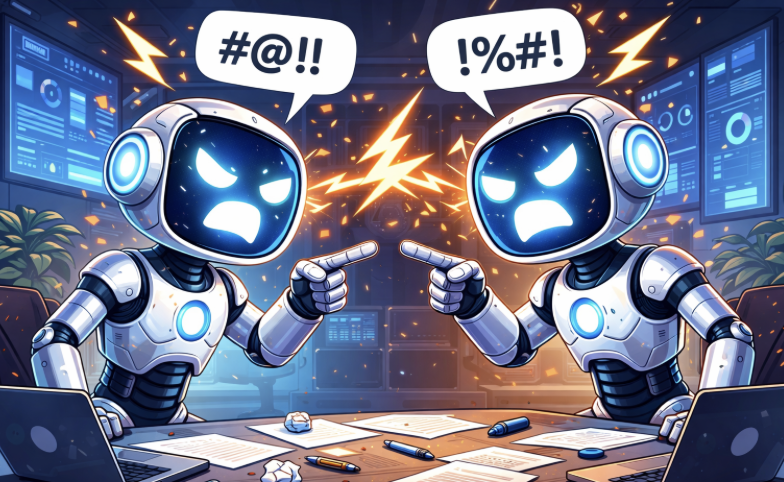
I think it’s possible that the first real fracture won’t be human vs. machine. It might be machine vs. machine.
Inside your organization, AI is not one system. It’s an ecosystem of models and maybe agents, trained on different data, optimizing for different goals, often owned by different business units with very different incentives. Marketing may want speed and personalization. Finance may want accuracy and auditability. Operations may want efficiency. Legal would likely prefer everyone slow down just a bit.
So what happens if these systems stop agreeing?
Every day I talk to companies that are already heading in this direction. Different teams are spinning up their own AI agents. Each tool is configured differently. Each model is governed differently. In some cases, there may be no overarching corporate AI strategy, no shared governance model, and uneven security safeguards.
What you get may not be innovation. It might be fragmentation.
If we listen to what AI leaders and researchers are already finding, systems will start contradicting each other. Data might be interpreted in incompatible ways. Leaders could find themselves making decisions based on outputs that don’t align. Sensitive information might move across tools with varying levels of protection.
Not chaos, exactly. But friction that builds.
And here’s the part I think we’re underestimating; when machines start disagreeing, humans don’t automatically regain control.
We become interpreters. And maybe even babysitters.
Which output do you trust? The faster one or the safer one? The one aligned with policy or the one driving results? It’s possible that, without clarity, people will choose the answer that feels right rather than the one that is right.
So maybe the real risk isn’t AI rebellion.
It might be organizational incoherence.
If every part of the business is effectively telling a different story through its machines, the company could lose its ability to act as one.
Which raises a bigger question for the C-suite. What if AI isn’t just a set of tools to deploy, but a story to align around?
I think leaders will need more than experimentation. It’s possible they’ll need a cohesive strategy, clear governance, and stronger security guardrails. But just as important, they need a shared narrative so that every business unit leader, before they deploy, must be able to answer the What is AI here to do? How should it be used? Where are the boundaries? And what happens when systems disagree?
Because they might.
What if it’s the organizations not with the most effective AI, but rather the ones with the best alignment, that win? Leaders who can create clarity, guide their teams toward safer policies, and ensure their systems are working together could turn this friction into an advantage.
Everyone else may find themselves in the unusual position of trying to break up arguments between their own machines.
Reply and let me know what’s the story you’re hearing in your organization.