
And no, I’m not talking about the Big 4 consulting firms or the Final Four.
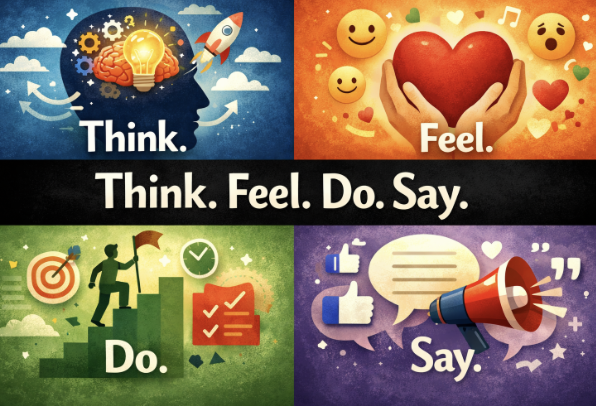
Before you build your next AI pilot, product demo, or stakeholder presentation, ask yourself the Big 4.
How do you explain something as complex and fast-moving as AI without losing your audience to their phones — or worse, to their anxiety?
Innovation Storytelling.
Over the next few newsletters, we’ll break down the process: why it works, how it functions neurologically, and how to apply it right now to your AI narrative.
But first, ask the Big 4:
What do you want them to —
Think.
Feel.
Do.
Say, when you’re done speaking?
THINK
Get ruthlessly clear about what you need your audience to remember when the meeting is over and their Slack notifications flood back in. In the age of AI, information overload is the default state. People are drowning in information, and you might be making it worse with 100 features and benefits or jargon. If you don’t engineer the takeaway, there won’t be one.
Storytelling is a memory-making device — but you have to feed it the right material. Jennifer Aaker’s research at Stanford shows stories are 22x more memorable than facts alone. Harvard Business Review confirms that the brain processes narrative differently, activating regions tied to experience and emotion, which makes the content significantly more sticky and impactful.
When you’re communicating AI — a topic already burdened with abstraction and hype — this matters enormously. Decide your core message before you write a single slide.
FEEL
You might think that a compelling benchmark, pristine data, or a flashy demo is enough to move people. It’s not. Humans don’t adopt AI tools, champion AI initiatives, or change workflows based on logic alone. Research published in the Journal of Experimental Psychology shows that emotional content is far more likely to be retained. That’s because emotional arousal actually facilitates memory encoding and retention.
So ask yourself: when your audience leaves the room, how do you want them to feel? Empowered? Relieved that their jobs are changing, not disappearing? Curious enough to try something new? Excited about what’s possible? Or perhaps appropriately cautious about what’s at stake?
You are the director of this experience. Assign an emotional intention to every slide of your presentation. The best AI storytellers don’t just explain the tech, they guide the audience through a specific emotional arc.
Because EMOTION DRIVES ACTION, not the data.
DO
What do you actually want your listener to do when you’re done talking? Have you created a compelling call to action? Do you know what’s needed next: a decision? A second meeting with other stakeholders? Funding? McKinsey research on emotional storytelling confirms that matching the emotion to the outcome you want is crucial in engaging and persuading audiences to drive measurable business outcomes.
Why? Because when people feel connected to a story, they’re willing to put their effort and their reputation behind it. The challenge in AI communication is that the stakes feel enormous and the path feels unclear. Your story needs to shrink the distance between understanding and action. Know your ask. Make it specific. Make it easy to say yes to.
SAY
Imagine what happens when your audience walks out of the room. What’s the first thing you want them to say when the next decision-maker asks, “Hey, what was that meeting about?”
In AI, where word-of-mouth and internal champions can make or break adoption, this matters more than almost anything else.
Your job: Pre-program the language they’ll say next.
Build Memory Triggers — soundbites, metaphors, and analogies that give people the words to carry your idea forward.
“AI as a co-pilot, not an autopilot.”
“We’re not replacing the team, we’re removing the drudgework.”
These phrases act as glue between your content and the feelings you’ve generated.
More importantly, they spread. They resurface in meetings and break rooms you’ll never be in.
Now, you’ve gone from director to copywriter. Memorable language is what takes your AI story from the conference room into the culture.
The disconnection crisis is real: audiences are more distracted, more skeptical, and more overwhelmed than ever — especially when the topic is AI. The Big 4 isn’t just a presentation framework. It’s how you cut through the noise and make your message matter.